
GEO • 8 min read
How to Get Your Clinic Cited by ChatGPT: A GEO Playbook for 2026
AI engines now answer "best dentist near me" directly, citing only a handful of sources. Here is exactly what determines whether your clinic is one of them - and a step-by-step plan to get cited.
The shift you cannot afford to ignore
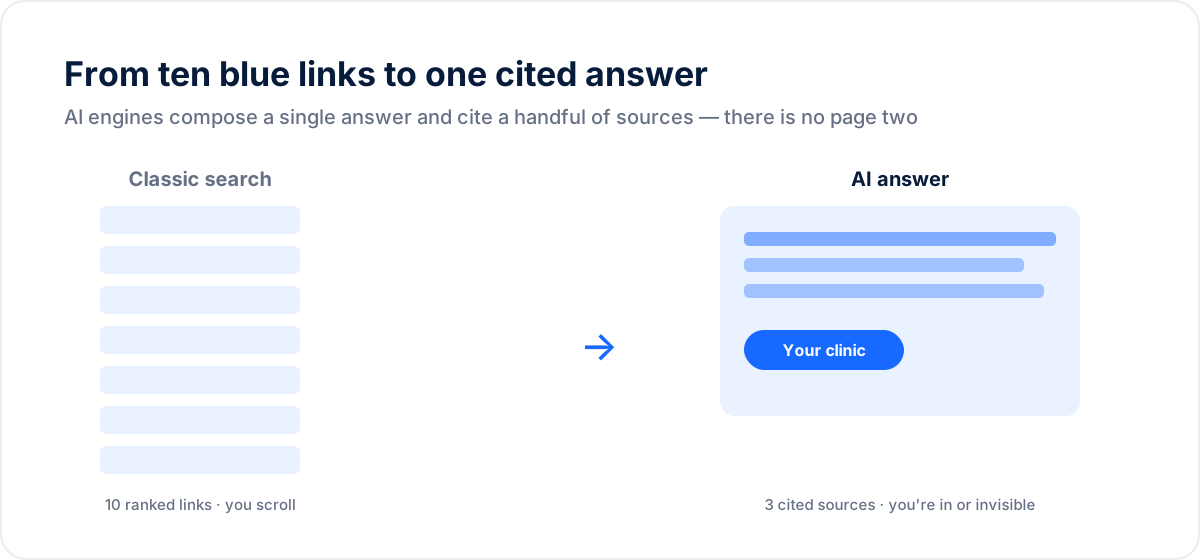
Patients increasingly ask ChatGPT, Google AI Overviews, Perplexity, and Gemini for clinic recommendations instead of scrolling Google's blue links. The mechanics are different in one decisive way: instead of ranking ten links, the AI engine composes a single answer and cites a handful of sources. There is no page two - your clinic is either in the answer or it does not exist for that patient.
This is what we call GEO, Generative Engine Optimization, and it is one of the few areas where clinics can still get ahead of their competition, because most have done nothing about it. The encouraging part: the inputs are concrete and overlap heavily with the local SEO work clinics should already be doing. This playbook walks through the signals that drive citations and the order to fix them.
Signal one: structure your content for extraction
AI engines quote pages that answer questions in their first sentences. A service page opening with "Direct-billing dental clinic in North York offering same-week appointments and accepting 20+ insurers" gives the engine a complete, liftable claim. A page opening with three paragraphs of brand storytelling gives it nothing.
Question-based subheadings followed by direct first-sentence answers are the core extractable unit. FAQ blocks at the bottom of every service page multiply them - each question-and-answer pair is a self-contained answer the engine can cite. Specific, attributable claims beat vague superlatives every time: "open until 8pm weekdays" is citable, "convenient hours" is not. The direct-billing positioning is ideal GEO material because it is specific and factual.
Signal two: your Google Business Profile and review themes
For local queries, AI engines lean heavily on the same data layer that powers the Map Pack: your Google Business Profile's categories, services, attributes, hours, photos, and reviews. A complete, active profile is the price of admission; an abandoned one removes you from consideration regardless of how good your website is.
Reviews function as evidence. Engines detect repeated themes across many reviews - "fast direct billing," "great with anxious patients," "wheelchair accessible" - and surface clinics whose review corpus matches the question. Thirty reviews mentioning direct billing make your clinic the answer to "dentist near me that direct-bills"; one review saying it is an anecdote. This is why a systematic review strategy is GEO work, not just reputation work.
Signal three: schema, consistency, and crawlability
Schema markup - LocalBusiness or the more specific Dentist and Physiotherapist types, plus FAQPage on pages with question blocks - gives engines machine-readable confirmation of who you are, where you are, what you do, and what you charge. It is the difference between an engine inferring your details and knowing them.
Consistency is the quiet multiplier: your name, address, phone, hours, and claims should match exactly across your website, profile, and directories. Contradictions read as unreliability, and engines deprioritize sources they cannot trust. Finally, your site must be crawlable by AI bots at all - robots.txt rules that block GPTBot, PerplexityBot, and their peers silently remove you from those engines' answers.
The test you can run in ten minutes
Open ChatGPT and search "best dentist in [your neighbourhood] that takes Manulife." Then "direct billing dentist near [landmark]." Then "emergency dentist [neighbourhood] open Saturday." Run seven to ten variations covering your services, insurers, and neighbourhoods, in ChatGPT and in a Google search that triggers an AI Overview. Note which clinics are cited and which are not.
If your clinic does not appear in most of these prompts, you have a GEO problem - and the competitors who do appear are quietly winning booking conversations you never see happening. Repeat the same prompt set monthly; visibility moves as you fix structure, and tracking it is the only way to know the work is landing.
The fix order that works
First: complete and activate your Google Business Profile - it is the fastest-moving input. Second: rewrite your service-page openings into direct answers and add FAQ blocks with schema. Third: run the review system so themes accumulate. Fourth: verify AI crawlers are allowed and your schema validates. Most clinics see their first AI citations within one to two months of doing these four things in order.
This is exactly what our AI Search Visibility Audit does in productized form: we test 15 high-intent prompts against your clinic, show you where you are cited and where you are absent, and hand you a prioritized action plan. If you would rather start smaller, send your URL through the contact page for a free Clinic Growth Score.
Frequently asked questions
Want to know if AI search engines cite your clinic?
Our AI Search Visibility Audit tests 15 high-intent prompts across ChatGPT, Google AI Overviews, and Perplexity - and tells you exactly what to fix. $750 flat, 10-page report.